

 Download PDF
DATASHEET SEARCH SITE
Document overview
- PDF pages: 2
Technical content
Page 1

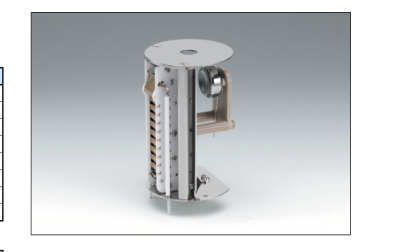
With Conversion Dynode, Off-axis Structure
for Gas / liquid QMS (Quadruple Mass Spectrometry)
SPECIFICATIONS
GENERAL
| Parameter | Description / Value | Unit |
|---|---|---|
| Input Aperture Diameter | 11 | mm |
| Dynode Structure | Conversion + box and linear focused | — |
| Number of Dynode Stages | 19 | — |
| First Dynode Material | Al2O3 | — |
| Total Built-in Resistance | 17.15 | MΩ |
| Operating Ambient Temperature | -30 to +50 | °C |
| Storage Temperature | -80 to +50 | °C |
| Polarity of Detected Ions | Positive / Negative | — |
MAXIMUM RATINGS
| Parameter | Value | Unit |
|---|---|---|
| Anode to First Dynode Voltage | -3000 | V |
| Anode to Last Dynode Voltage | 350 | V |
| Conversion Supply Voltage | ±10 | kV |
| Operating Vacuum Level | 1 × 10⁻² | Pa |
| Bake-Out Temperature (at 5 × 10⁻³ Pa) Average Anode CurrentA | No baking 10 | — µA |
| Operating Gain | 1 × 10⁸ | — |
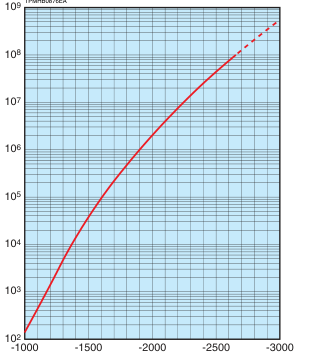
Figure 1: Typical Gain TPMHB0876EA
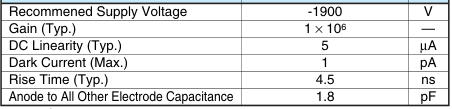
CHARACTERISTICS
Unit
Parameter
Value
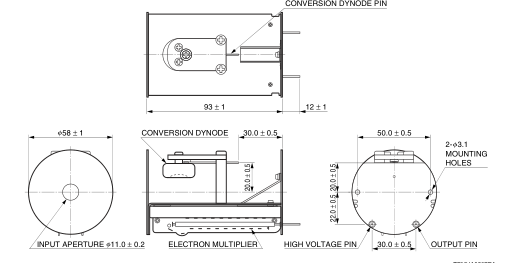
NOTE: A Averaged over any interval of 30 seconds maximum. Figure 2: Dimensional Outline (Unit: mm)
SUPPLY VOLTAGE (V)
TPMHA0587EA
Subject to local technical requirements and regulations, availability of products included in this promotional material may vary. Please consult with our sales office. Information furnished by HAMAMATSU is believed to be reliable. However, no responsibility is assumed for possible inaccuracies or omissions. Specifications are subject to change without notice. No patent rights are granted to any of the circuits described herein. ©2014 Hamamatsu Photonics K.K.
Page 2
ELECTRON MULTIPLIER R6985-80
POSITIVE ION / NEGATIVE ION DETECTION MECHANISM
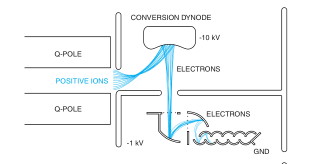
When positive ions strike the conversion dynode, electrons are emitted from the conversion dynode according to the quantity of input ions. These emitted electrons are then guided into the electron multiplier for secondary multiplication.
When negative ions strike the conversion dynode, positive ions are emitted from the conversion dynode according to the quantity of input ions. These emitted positive ions then enter the electron multiplier while receiving energy from the difference in potential
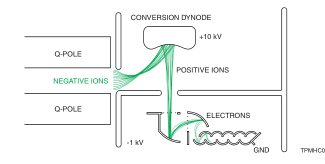
between the conversion dynode and electron multiplier, and strike the first dynode of the electron multiplier where electrons are released according to the quantity of input positive ions. These electrons are then guided to the second and subsequent dynodes for secondary multiplication.
TPMHC0248EA
HAMAMATSU PHOTONICS K.K.
www.hamamatsu.com
HAMAMATSU PHOTONICS K.K., Electron Tube Division 314-5, Shimokanzo, Iwata City, Shizuoka Pref., 438-0193, Japan, Telephone: (81)539/62-5248, Fax: (81)539/62-2205 U.S.A.: Hamamatsu Corporation: 360 Foothill Road, Bridgewater. N.J. 08807-0910, U.S.A., Telephone: (1)908-231-0960, Fax: (1)908-231-1218 E-mail: usa@hamamatsu.com Germany: Hamamatsu Photonics Deutschland GmbH: Arzbergerstr. 10, D-82211 Herrsching am Ammersee, Germany, Telephone: (49)8152-375-0, Fax: (49)8152-2658 E-mail: info@hamamatsu.de France: Hamamatsu Photonics France S.A.R.L.: 19, Rue du Saule Trapu, Parc du Moulin de Massy, 91882 Massy Cedex, France, Telephone: (33)1 69 53 71 00, Fax: (33)1 69 53 71 10 E-mail: infos@hamamatsu.fr
United Kingdom: Hamamatsu Photonics UK Limited: 2 Howard Court, 10 Tewin Road, Welwyn Garden City, Hertfordshire AL7 1BW, United Kingdom, Telephone: (44)1707-294888, Fax: (44)1707-325777 E-mail: info@hamamatsu.co.uk North Europe: Hamamatsu Photonics Norden AB: Torshamnsgatan 35 SE-164 40 Kista, Sweden, Telephone: (46)8-509-031-00, Fax: (46)8-509-031-01 E-mail: info@hamamatsu.se Italy: Hamamatsu Photonics Italia S.r.l.: Strada della Moia, 1 int. 6, 20020 Arese (Milano), Italy, Telephone: (39)02-93581733, Fax: (39)02-93581741 E-mail: info@hamamatsu.it
TPMH1339E02
China: Hamamatsu Photonics (China) Co., Ltd.: B1201 Jiaming Center, No.27 Dongsanhuan Beilu, Chaoyang District, Beijing 100020, China, Telephone: (86)10-6586-6006, Fax: (86)10-6586-2866 E-mail: hpc@hamamatsu.com.cn
AUG. 2014 IP