

 Download PDF
R331 HAMAMATSU
Document overview
- PDF pages: 4
Technical content
Page 1
PHOTOMULTIPLIER TUBES
R331, R331-05
For Liquid Scintillation Counting
Bialkali Photocathode, 51mm (2 Inch) Diameter, 12 Stages, Head-On Type
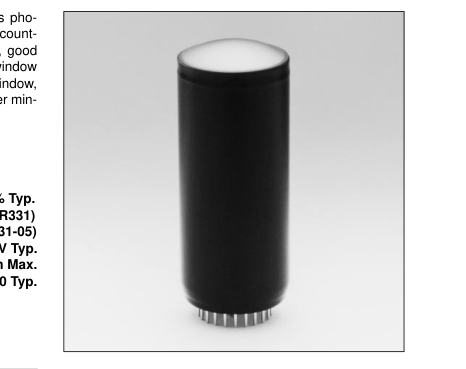
The R331 and the R331-05 are 51mm (2 Inch) diameter series photomultiplier tubes specifically developed for the liquid scintillation counting. They feature low background noise, high tritium efficiency, good linearity and high gain. The R331 uses a synthetic silica input window and the R331-05 uses a low K content borosilicate glass input window, both with a frosted surface and convex-concave shape. They offer minimized glass scintillations and high collection efficiency.
FEATURES
Tritium efficiency in tritium window................................ 60% Typ. Background noise in tritium window...............16cpm Typ. (R331) 18cpm Typ. (R331-05) Tritium end point (T.E.P.) voltage.................................. 1700V Typ. Dark pulse summation at T.E.P. voltage.............. 3 × 10⁴cpm Max. Figure of merit (E2/B).......................................................... 200 Typ.
GENERAL
| Parameter | R331 | R331-05 | Unit | |
|---|---|---|---|---|
| Spectral Response | 160 to 650 | 300 to 650 | nm | |
| Wavelength of Maximum Response | 420 | nm | ||
| Photo- cathode | Material | Bialkali | — | |
| Minimum Useful Area | 46 | mm dia. | ||
| Window Material | Material | Synthetic silica (Frosted) | Low K content borosilicate glass (Frosted) | — |
| Shape | Concave-Convex | — | ||
| Dynode | Structure | Linear focused | — | |
| Number of Stages | 12 | — | ||
| Direct Interelectrode Capacitances | Anode to Last Dynode | 2 | pF | |
| Anode to All Other Electrodes | 2.5 | pF | ||
| Base | 21-pin glass base | — | ||
| Weight | 151 | g | ||
| Suitable Socket | E678-21A (Supplied) | — | ||
Figure 1: Typical Spectral Response TPMHB0505EA 100
CATHODE RADIANT
R331
SENSITIVITY
10
R331-05
QUANTUM EFFICIENCY
1
0.1
0.01 200 400 600 800
WAVELENGTH (nm)
Subject to local technical requirements and regulations, availability of products included in this promotional material may vary. Please consult with our sales office. Information furnished by HAMAMATSU is believed to be reliable. However, no responsibility is assumed for possible inaccuracies or omissions. Specifications are subject to change without notice. No patent rights are granted to any of the circuits described herein. © 1998 Hamamatsu Photonics K.K.
Page 2
PHOTOMULTIPLIER TUBES R331, R331-05
MAXIMUM RATINGS (Absolute Maximum Values)
| Parameter | Value | Unit | |
|---|---|---|---|
| Supply Voltage | Between Anode and Cathode | 2500 | Vdc |
| Between Anode and Last Dynode | 500 | Vdc | |
| Average Anode Current A | 0.2 | mA | |
| Ambient Temperature | -80 to +50 | °C | |
CHARACTERISTICS (at 25°C)
| Parameter | Min. | Typ. | Max. | Unit | |
|---|---|---|---|---|---|
| Cathode Sensitivity | Luminous B | 60 | 90 | — | µA/lm |
| Quantum Efficiency at 390nm | — | 25 | — | % | |
| Radiant at 420nm | — | 85 | — | mA/W | |
| Blue C | 9.0 | 10.5 | — | µA/lm-b | |
| Anode Sensitivity | Luminous D | 30 | 120 | — | A/lm |
| Radiant at 420nm | — | 1.1 × 10⁵ | — | A/W | |
| Gain D | — | 1.3 × 10⁶ | — | — | |
| Anode Dark Count E | R331 | — | 16 | — | cpm |
| R331-05 | — | 18 | — | cpm | |
| Time ResponseD | Anode Pulse Rise Time F | — | 2.6 | — | ns |
| Electron Transit Time G | — | 48 | — | ns | |
| Transit Time Spread H | — | 1.1 | — | ns | |
Table 1: Voltage Distribution Ratio
NOTES
A: Averaged over any interval of 30 seconds maximum and the whole photocathode is illuminated. B: The light source is a tungsten filament lamp operated at a distribution temperature of 2856K. The light input is 0.01 lm and 150 volts are applied between the cathode and all other electrodes connected together as anode. C: The value is cathode output current when a blue filter (Corning CS 5-58 polished to 1/2 stock thickness) is interposed between the light source and the tube under the same condition as Note B. D: Measured with the same light source as Note B and the light input is 0.1µlm. The anode-to-cathode supply voltage and voltage distribution ratio are shown in Table 1.
E: Background noise after 30 minute storage in darkness. F: The rise time is the time for the output pulse to rise from 10% to 90% of the peak amplitude when the entire photocathode is illuminated by a delta function light pulse of 400nm. G: The electron transit time is the interval between the arrival of a delta function light pulse at the input window of the tube and the time when the output pulse reaches the peak amplitude. In measurement the entire photocathode is illuminated. H: Also called transit time jitter. This is the fluctuation in electron transit time between individual pulses in the single photoelectron state, and may be defined as the FWHM of the frequency distribution of the transit times.
K G Dy1 Dy2 Dy3 Dy4 Dy5 Dy6 Dy7 Dy8 Dy9 Dy10Dy11Dy12
P
Electrodes
4 0 1 1.4 1 1 1 1 1 1 1
1 1 1
Distribution Ratio Supply Voltage: 1500Vdc, K: Cathode, Dy: Dynode, P: Anode, G: Grid \* Shield should be connected to Dy5.
Page 3
Figure 2: Typical Anode Luminous Sensitivity and
Gain
TPMHB0506EA
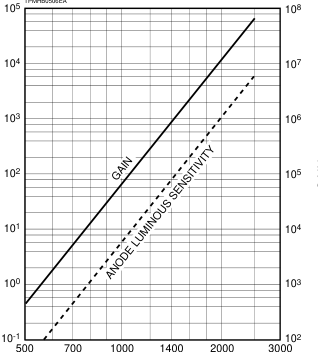
SUPPLY VOLTAGE (V)
Figure 4: Typical Time Response
TPMHB0508EA
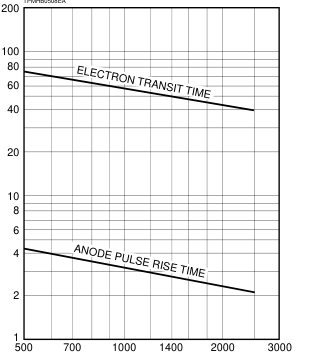
SUPPLY VOLTAGE (V)
Figure 3: Typical Anode Output Wave form
TPMHB0507EA
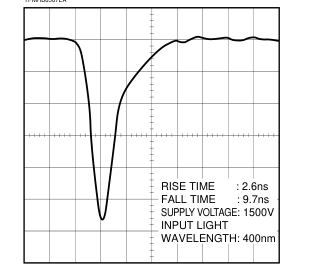
(5ns/div)
Figure 5: Typical Transit Time Spread
TPMHB0510EA
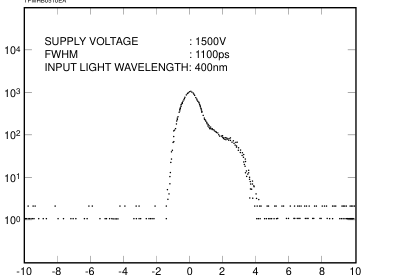
TIME (ns)
Page 4
PHOTOMULTIPLIER TUBES R331, R331-05
Figure 6: Dimensional Outline and Basing Diagram (Unit: mm)
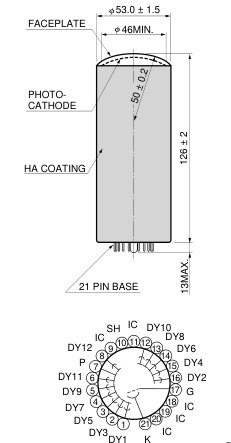
Socket (Supplied)
(E678-21A)
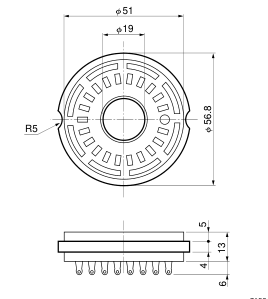
TACCA0011EA
TPMHA0072EB
\* Shield (SH) should be connected to Dy5.
HAMAMATSU PHOTONICS K.K., Electoron Tube Center 314-5, Shimokanzo, Toyooka-village, Iwata-gun, Shizuoka-ken, 438-0193, Japan, Telephone: (81)539/62-5248, Fax: (81)539/62-2205 U.S.A.: Hamamatsu Corporation: 360 Foothill Road, P. O. Box 6910, Bridgewater. N.J. 08807-0910, U.S.A., Telephone: (1)908-231-0960, Fax: (1)908-231-1218 Germany: Hamamatsu Photonics Deutschland GmbH: Arzbergerstr. 10, D-82211 Herrsching am Ammersee, Germany, Telephone: (49)8152-375-0, Fax: (49)8152-2658 France: Hamamatsu Photonics France S.A.R.L.: 8, Rue du Saule Trapu, Parc du Moulin de Massy, 91882 Massy Cedex, France, Telephone: (33)1 69 53 71 00, Fax: (33)1 69 53 71 10 United Kingdom: Hamamatsu Photonics UK Limted: Lough Point, 2 Gladbeck Way, Windmill Hill, Enfield, Middlesex EN2 7JA, United Kingdom, Telephone: (44)181-367-3560, Fax: (44)181-367-6384
North Europe: Hamamatsu Photonics Norden AB: Färögatan 7, S-164-40 Kista Sweden, Telephone: (46)8-703-29-50, Fax: (46)8-750-58-95
TPMH1209E01
Italy: Hamamatsu Photonics Italia: S.R.L.: Strada della Moia, 1/E, 20020 Arese, (Milano), Italy, Telephone: (39)02-935 81 733, Fax: (39)02-935 81 741
JUL. 1998