
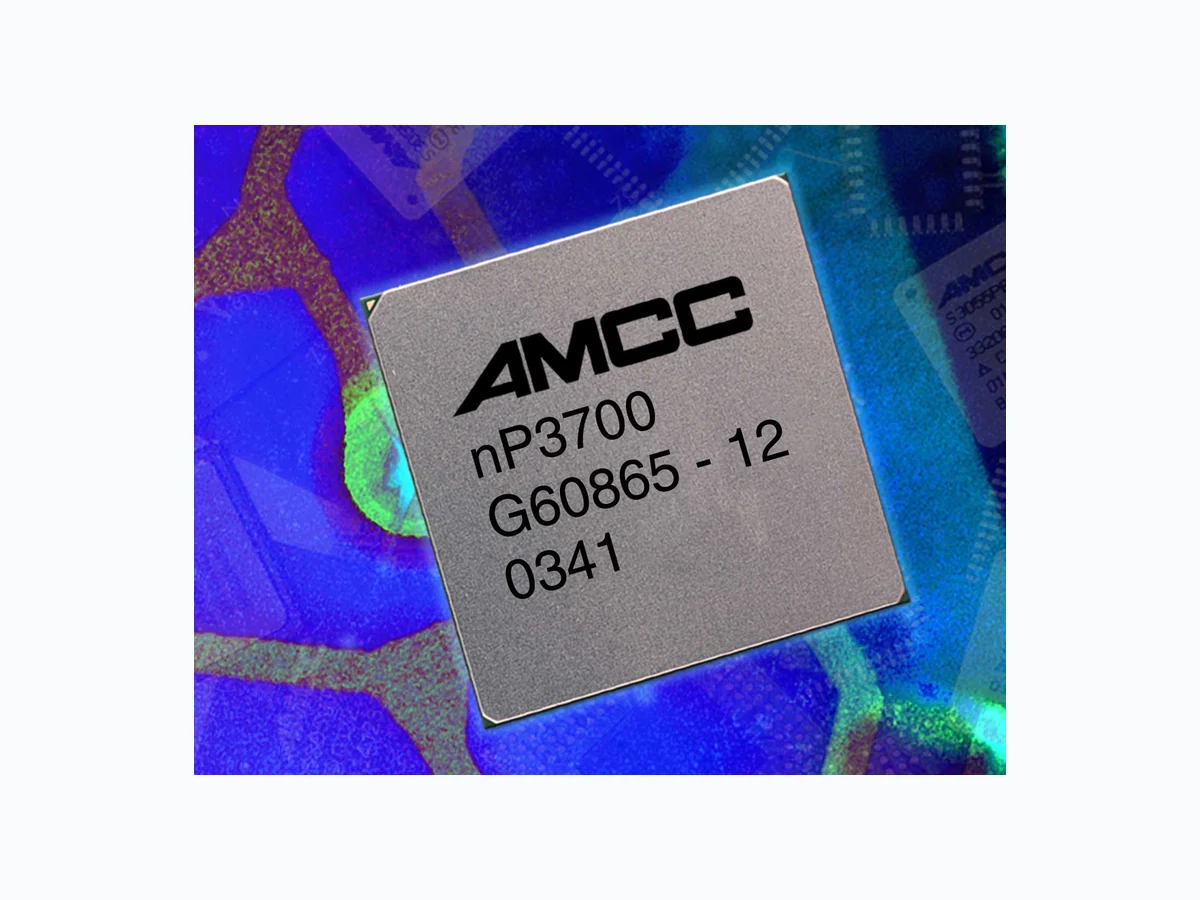
NP3700 ETC
Document overview
- Manufacturer or author: Provided By www.digicamel.com(FREE DATASHEET DOWNLOAD SITE)
- PDF pages: 4
Technical content
Features
n P5 Technology Mix and match Gigabit Ethernet, POS, and ATM traffic Standalone or as a line card in a larger system Proven nPcore Architecture 3 nPcores at 700 MHz optimized for network processing Single-stage single-image programming model High-speed RLDRAM-II, DDR-II memory interfaces for payload and context storage Per-flow metering and statistics for millions of flows Integrated Traffic Manager Per-flow queuing and scheduling Sophisticated, fine-grained scheduling algorithms Standards-Compliant Interfaces Integrated GE MACs (GMII) OIF SPI-3, OIF SPI-4 Phase 2
Applications
Multi-Service Switches Core, Edge Routers, DSLAMs OC-48 AAL5 SAR L4-L7 Applications Benefits High integration: Significant form factor, cost, and power savings Hardware-based Traffic Manager for guaranteed performance Software compatibility with previous generation nP devices: nP34xx, nP7250 Simple programming model for rapid development and quick time-to-market Software portability ATM and packet internetworking for multi-service applications nP3700 Interface Diagram DRAM DRAM DRAM DRAM nP3700 DRAM DRAM DRAM DRAM Search Memory/ Co-Processor Control Plane CPU GE /PPC SPI4.2 SPI3/UT3 QDR QDR SPI3/UT3 DRAM DRAM DRAM DRAM nP3700 DRAM DRAM DRAM DRAM Search Memory/ Co-Processor Control Plane CPU GE /PPC SPI4.2 SPI3/UT3 QDR QDR SPI3/UT3
5-Gbps Network Processor with Integrated Traffic ManagerPB37xx / V0.92 / 053003
2 Empowering Intelligent Wide Area Networks
Line Interfaces – cell and packet Support for Deep Channelization: for OC-1s, T3/E3s, T1/E1s, etc. Fabric Interface: OIF SPI-4 Phase 2 - 800 MHz External Memory Interfaces: RLDRAM II memory controllers - Payload Memory – 2 banks of 36-bit RLDRAM II or DDR SDRAM operating at up to 250 MHz (32 Gbps with ECC) - Context Memory: 2 banks of 36-bit RLDRAM II or DDR SRAM operating at up to
250 MHz (32 Gbps with ECC)
- Channel Service Memory: One bank of 36-bit QDR-II SRAM operating at up to 250 MHz - Flow Database Memory: Two banks of 18-bit QDR-II SRAM operating at up to 250 MHz CPU Interfaces: PowerPC and Gigabit Ethernet External Search Interface - Compliant with NPF - Backward compatibility mode with existing TCAMs Debug port JTAG port High Performance nPcores 3 nPCores at 700 MHz Integrated Coprocessors Policy Engine for efficient packet classification Special Purpose Unit (SPU) for per- flow policing Hashing Unit On-Chip Debugger (OCD) Integrated Traffic Manager Hierarchical Traffic Manager with fine-grained flow-based traffic management Leverages field-proven nPX5710 and nPX5720 technology SPI-3 GE SPI-4.2 nP3700 2 1 1 nP3700 Block Diagram SPI3/UT3 SPI3/UT3 SPI4.2 nPcores 3 cores @ 700 MHz SPU Packet Transform Engine Traffic Manager Queuing Scheduling (Switch Fabric) Channel buffers Policy Engine DRAM Line Interfaces CPU Interface Debug JTAG FABRIC INTERFACE PPC 36 36 36 36 Cache Hash Engine Scratch Pad Memory Access Unit NPF(QDR) QDR DRAM/SRAM 36 3618 GE (Line/CPU) SPI3/UT3 SPI3/UT3 SPI4.2 nPcores 3 cores @ 700 MHz SPU Packet Transform Engine Traffic Manager Queuing Scheduling (Switch Fabric) Channel buffers Policy Engine DRAM Line Interfaces CPU Interface Debug JTAG FABRIC INTERFACE PPC 36 36 36 36 Cache Hash Engine Scratch Pad Memory Access Unit NPF(QDR) QDR DRAM/SRAM 36 3618 GE (Line/CPU)
Empowering Intelligent Optical Networks Product BriefnP3700 5-Gbps Network Processor with Integrated Traffic Manager PB37xx / V0.92 / 053003 Empowering Intelligent Wide Area Networks 3 nPcore Architecture AMCC's software programmable nPcores are built from the ground up for both packet- and cell-based networking data-plane operations. The nP3700 supports 5-Gbps full-duplex operation utilizing a cluster of three nPcores. Each nPcore has 24 separate tasks, yielding a total of 72, which are all available for either ingress or egress processing. The nPcores implement zero-cycle task switching and zero-cycle branching for enhanced performance. The nPcores are surrounded by on-chip coprocessing engines to accelerate sophisticated network processing functions, such as packet classification, route and context searching, statistics gathering, metering, policing, and packet transformations. The nPcores, in combination with these on-chip coprocessing engines, implement Network Instruction Set Computing (NISC) Architecture. This NISC architecture dramatically reduces the number of lines of code required to implement many advanced networking tasks. A key addition to the fifth generation of NISC architecture is the exception channel processing that provides flexibility in handling packets that require increased processing time. This exception channel handles special packets through a secondary path, without affecting the deterministic line- rate performance of the regular packets in the primary path. Another key addition to the fifth generation architecture is the Channel Service Memory that enables deep channelization in the line interfaces at all packet sizes and can handle very large bursts in the incoming traffic without affecting line rate performance. Single-Stage, Single-Image Programming AMCC's nPcore architecture implements a simple single-stage programming model. In this model each cell or packet is processed in its entirety, from start to finish, by a single task in a single nPcore. With this single-stage model, the entire data flow algorithm can be created as a single complete software program, just as it would be on a non- multiprocessor system, allowing the same program image to be executed identically by each task on each nPcore. This approach greatly simplifies programming while optimizing performance. Traffic Management The traffic management block in the nP3700 leverages AMCC’s expertise and technology from the nPX5700 family of traffic managers. The nP3700 family implements a hierarchical scheduling architecture to provide multiple levels of bandwidth provisioning and per-subscriber guarantees. This hierarchy consists of four logical levels: flow, pipe, subport and port. Minimum and maximum bandwidth control can be configured on multiple levels. WFQ and Strict Priority scheduling algorithms are also implemented by the traffic management block. For ATM applications, non-real- time and real-time CBR and VBR connections can be configured for a desired subset of flows. Input Admission Control Sophisticated cell and packet admission controls are configurable in the nP3700. This includes execution of standard discard mechanisms such as WRED, EPD, and TPD in hardware or the option to perform variations in software. MISSION TM — Multi-Service Internetworking Solution The nP3700, combined with AMCC’s Evros (S1208) and Tigris (S4811) chips, provides a cost-effective and highly flexible multi-service solution. This solution, called MISSION, combines state-of-the-art framer, HDLC, and flexible nP 5 technology with modular internetworking software, enabling the development of single multiprotocol solutions in place of multiple single- protocol solutions. The MISSION architecture provides equipment vendors with solutions that enable their customers to save on both capital and operational expenditures (CapEx/OpEx). MISSION Software At the core of the MISSION value proposition is software that implements a wide variety of protocols on the chip set and enables flexible potential additions to these base software features. AMCC provides integrated drivers for Evros, Tigris, and nP3700, and extensive offerings for the programmable nP3700 Integrated Network Processors, including both rich off-the-shelf application software and a complete development environment for extending this application base if desired. The MISSION application software includes ready-to-use Multi-Service Switching software – ATM UNI/NNI, Inverse Multiplexing over ATM (IMA), Multi-Link Frame Relay (ML-FR), Multi- Link PPP (ML-PPP), Frame Relay Interworking (FRIWF) and MPLS Martini encapsulation – as well as OEM customer-extensible libraries for the hardware-resident aspects of higher layer applications such as IPv4 and IPv6 routing, and Layer 2 packet switching.
AMCC reserves the right to make changes to its products, or to discontinue any product or service without notice, and advises its customers to obtain the latest version of relevant information to verify, before placing orders, that the information being relied upon is current. AMCC is a registered trademark and MISSION, nPsoft, nPcore, and nP5 are trademarks of Applied Micro Circuits Corporation. Copyright © 2003 Applied Micro Circuits Corporation. All Rights Reserved. 6290 Sequence Drive San Diego, CA 92121 Tel: 858 450-9333 Fax: 858 450-9885 http://www.amcc.com For technical support, please call 800 840-6055 or email productsupport@amcc.com Product Brief nP3700 5-Gbps Network Processor with Integrated Traffic ManagerPB37xx / V0.92 / 053003
4 Empowering Intelligent Wide Area Networks
POS and ATM 2xSPI-3, SPI-4.2 Any type of OC-n channelization Flexible bandwidth allocation For example, Full-duplex OC-48, OC-12 plus 12xOC-3 Ethernet 10/100/1000 Ethernet Interface for Line or Host CPU Can mix Ethernet ports and SPI-3 ports For example, OC-48c and Gigabit Ethernet Deep Channelization Allows fractional T3/E3 and T1/E1 logical channels Can receive interleaved chunks of jumbo packets, perform packet processing on each chunk separately, and reassemble a jumbo packet in the fabric. nPcore Performance 3 nPcores running at 700 MHz 24 tasks per nPcore, total 72 tasks 64 KB instruction space, 16K instructions Dynamic Task Allocation Zero Cycle Task Switching Integrated Co-Processors Policy Engine — Efficient packet classification SPU — Data coherency Enables Single and Dual Leaky Bucket and Token Bucket policing on cells and frames Hash Engine — Programmable engine to accelerate table lookups Programmable Polynomial (for example, CRC generation) Statistics Engine Programmable Statistics Collection Traffic Management Standard Discard Mechanisms W R E D Dynamic queue limits EPD and CLP marking Payload memory requirements Up to 2 million cells of storage RLDRAM II or DDR SDRAM Supports DiffServ Per-flow queuing and scheduling 128K ingress and egress flows Strict Priority, Min, WRR Rate-shaping (CBR, VBR) 4K pipes Strict Priority, Min, Weight, Max 512 subports Min, Max, WRR nPsoft Development Environment nPsoft Services Simplified multiprocessor programming model Powerful NPU and CPU software and messaging framework nPkernel NPU operating system Open APIs, tracking standards nP Workbench Software development system Modular interfaces nPsoft Application Libraries Reference source code for WAN and LAN protocols nPsoft Toolkit Code development tools Graphical simulators Customizable debugger Performance analysis Product Availability Samples Q1 ‘04 Commercial and Industrial Temperature Rating