
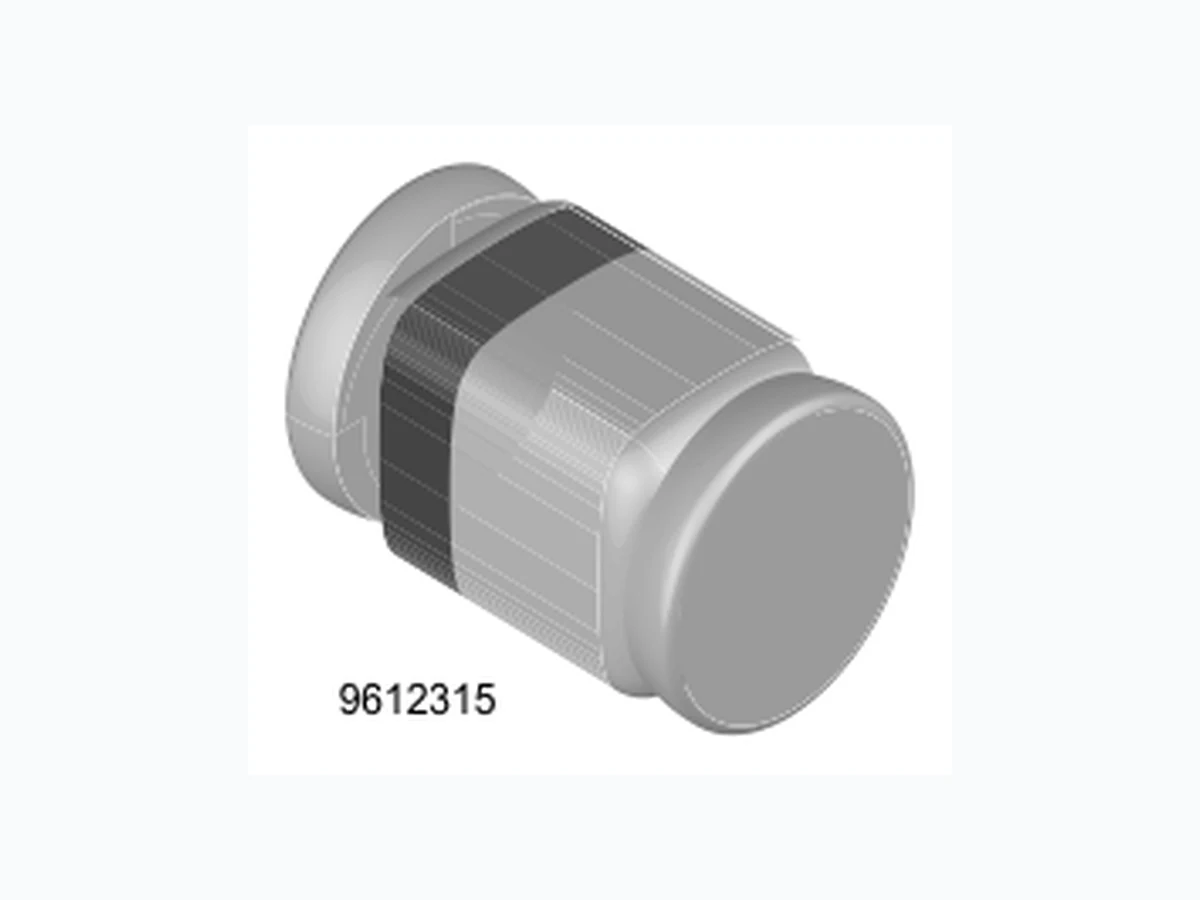
MCL4148_06 VISHAY
Document overview
- Manufacturer or author: Provided By www.digicamel.com(free datasheet download site)
- PDF pages: 6
Technical content
Features
- Silicon Epitaxial Planar Diodes Saving space Hermetic sealed parts Fits onto SOD323 / SOT23 footprints Electrical data identical with the devices 1N4148 and 1N4448 respectively Micro Melf package Lead (Pb)-free component Component in accordance to RoHS 2002/95/EC and WEEE 2002/96/EC
Applications
Extreme fast switches Mechanical Data Case: MicroMELF Glass case Weight: approx. 12 mg Cathode Band Color: Black Packaging Codes/Options: TR3 / 10 k per 13" reel (8 mm tape), 10 k/box TR / 2.5 k per 7" reel (8 mm tape), 12.5 k/box Parts Table Absolute Maximum Ratings Tamb = 25 °C, unless otherwise specified Part Type differentiation Ordering code Remarks MCL4148 V RRM = 100 V, VF at IF 50 mA = 1 V MCL4148-TR3 or MCL4148-TR Tape and Reel MCL4448 V RRM = 100 V, VF at IF 100 mA = 1 V MCL4448-TR3 or MCL4448-TR Tape and Reel Parameter Test condition Symbol Value Unit Repetitive peak reverse voltage V RRM 100 V Reverse voltage V R 75 V Peak forward surge current t p = 1 µs I FSM 2A Repetitive peak forward current I FRM 450 mA Forward continuous current I F 200 mA Average forward current V R = 0 I FAV 150 mA Power dissipation P tot 500 mW
Figure 3. Reverse Current vs. Reverse Voltage Figure 4. Diode Capacitance vs. Reverse Voltage Figure 5. Board for RthJA definition (in mm)
1000 I- Reverse Current (nA) R
www.vishay.com Document Number 85566 Rev. 1.9, 07-Mar-06 MCL4148 / MCL4448 Vishay Semiconductors Package Dimensions in mm (Inches) ISO Method E 9612072 2.8 (0.110) Reflow Soldering Wave Soldering 1.0 (0.039) 1.4 (0.055) Cathode indification 1 (0.039) s urface plan 2.0 (0.079) 1.8 (0.071) 0.25 (0.010) 0.15 (0.006) 1.2 (0.047) 1.1 (0.043) Glass case MicroMELF Glass< 1.35 (0.053 > R 2.5 (R 0.098) Glass 0.6 (0.024) surface plan Document No.: 6.560-5007.01-4 Rev. 11, 07.Feb.2005 1.2 (0.047) 2.4 (0.094) 0.8 (0.031)
Rev. 1.9, 07-Mar-06 Vishay Semiconductors www.vishay.com Ozone Depleting Substances Policy Statement It is the policy of Vishay Semiconductor GmbH to 1. Meet all present and future national and international statutory requirements. 2. Regularly and continuously improve the performance of our products, processes, distribution and operating systems with respect to their impact on the health and safety of our employees and the public, as well as their impact on the environment. It is particular concern to control or eliminate releas es of those substances into the atmosphere which are known as ozone depleting substances (ODSs). The Montreal Protocol (1987) and its London Amendments (1990) intend to severely restrict the use of ODSs and forbid their use within the next ten years. Various national and international initiatives are pressing for an earlier ban on these substances. Vishay Semiconductor GmbH has been able to use its policy of continuous improvements to eliminate the use of ODSs listed in the following documents. 1. Annex A, B and list of transitional substances of the Montreal Protocol and the London Amendments respectively 2. Class I and II ozone depleting substances in the Clean Air Act Amendments of 1990 by the Environmental Protection Agency (EPA) in the USA 3. Council Decision 88/540/EEC and 91/690/EEC Annex A, B and C (transitional substances) respectively. Vishay Semiconductor GmbH can certify that our semiconductors are not manufactured with ozone depleting substances and do not contain such substances. We reserve the right to make changes to improve technical design and may do so without further notice. Parameters can vary in different applications. All operating parameters must be validated for each customer application by the customer. Should the buyer use Vishay Semiconductors products for any unintended or unauthorized application, the buyer shall indemnify Vishay Semiconductors against all claims, costs, damages, and expenses, arising out of, directly or indirectly, any claim of personal damage, injury or death associated with such unintended or unauthorized use. Vishay Semiconductor GmbH, P.O.B. 3535, D-74025 Heilbronn, Germany
Document Number: 91000 www.vishay.com Revision: 18-Jul-08 1 Disclaimer Legal Disclaimer Notice Vishay All product specifications and data are subject to change without notice. Vishay Intertechnology, Inc., its affiliates, agents, and employees, and all persons acting on its or their behalf (collectively, “Vishay”), disclaim any and all liability for any errors, inaccuracies or incompleteness contained herein or in any other disclosure relating to any product. Vishay disclaims any and all li ability arising out of the use or application of any product described herein or of any information provided herein to the maximum extent permit ted by law. The product specifications do not expand or otherwise modify Vishay’s terms and conditions of purcha se, including but not limited to the warranty expressed therein, which apply to these products. No license, express or implied, by estoppel or otherwise, to any intellectual property rights is granted by this document or by any conduct of Vishay. The products shown herein are not designed for use in medi cal, life-saving, or life-sustaining applications unless otherwise expressly indicated. Customers using or selling Vishay products not expressly indicated for use in such applications do so entirely at their own risk and agree to fully indemnify Vishay for any damages arising or resulting from such use or sale. Please contact authorized Vishay personnel to obtain written terms and conditions regarding products designed for such applications. Product names and markings noted herein may be trademarks of their respective owners.