


 Download PDF
85211015 HUBERSUHNER
Document overview
- PDF pages: 3
Technical content
Page 1
1/3
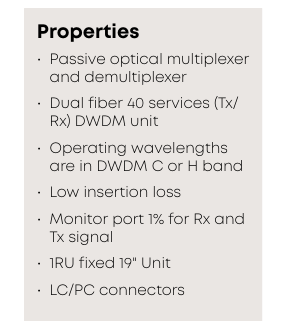
40 DWDM Dual Fiber Mux/DeMux
X20060-2DM40_NNM1U-55
General data
| Formfactor | Fixed unit |
|---|---|
| Width | 482.6 mm |
| Depth | 161 mm |
| Height | 39.25 mm |
| Weight | < 2.5 kg |
| Operating Temperature | -40 °C ... 70 °C |
| Storage temperature | -40 °C ... 85 °C |
Optical Perormance
| Number of channels | 2x 40 |
| Grid | DWDM |
| Operating channels | see Ordering Information according to DWDM ITU-T G.694.1 standard |
| Upgrade port(s) | Monitor: 1260 to 1620 nm |
| Channel spacing (GHz) | 100 GHz |
| Channel width | DWDM channels: ITU +/-0.11nm |
| 1dB Passband >= 0.23nm 3dB Passband >= 0.42nm | |
| Insertion loss DWDM | < 3.5 dB |
| Insertion loss monitor port | < 22 dB |
| Insertion loss remarks | Insertion loss at room operating temperature (+0.2dB over full temperature range). Insertion loss value @ITU center wavelength |
| Isolation adjacent channels | > 27 dB (DWDM) |
| Isolation no adjacent channels | > 30 dB (DWDM) |
| Isolation spectral range | 1260 nm ... 1620 nm |
Page 2
2/3
40 DWDM Dual Fiber Mux/DeMux
X20060-2DM40_NNM1U-55
Optical Perormance
| Isolation remark | Far-end crosstalk (demux) Near-end crosstalk (mux) |
| Optical return loss | ≥ 45 dB |
| Directivity | > 50 dB |
| Polarization dependent loss | < 0.5 dB |
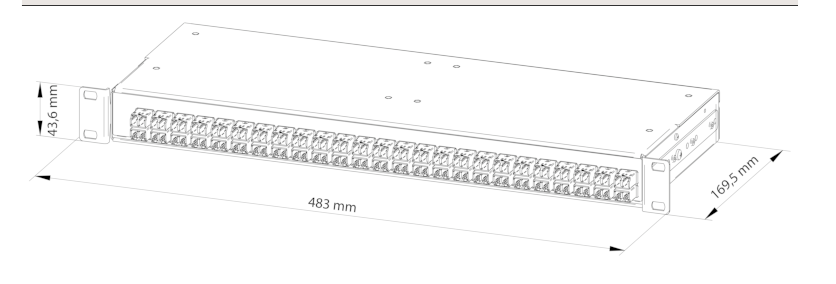
Technical drawing
Diagram

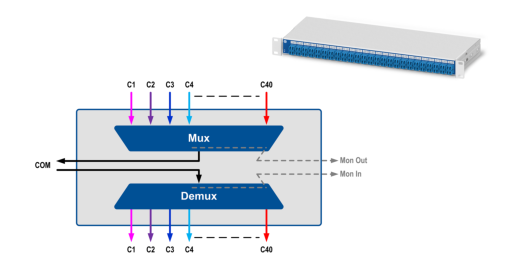
Connection Scheme

Ordering Information Table
| Item number | Item description | Type |
|---|---|---|
| 85211015 | X20060-2DM40-2000-NNM1U-55 | Channels: C20 to C59 |
Page 3
3/3
40 DWDM Dual Fiber Mux/DeMux
X20060-2DM40_NNM1U-55
Upgrade/Extension Port Definitions
| Standard upgrade port (UG) | This is the most commonly used upgrade port for optical multiplexers as it is the most cost efective. From a technical point of view, it is simply the reflect light of the multiplexer/ demultiplexer. In other words, no additional filtering (hence most cost efective) resulting in the least favorable insertion loss and isolation values of all upgrade port types. The standard upgrade port is available for both CWDM and DWDM modules. |
|---|---|
| Daisy-Chain Upgrade Port (dUG) | This upgrade port has a dedicated band-pass-filter and is integrated into the multiplexer/demultiplexer in such a way to minimize the insertion loss of the upgrade port. The low insertion loss of the upgrade port makes it ideal for a daisy- chain setup. The daisy-chain upgrade port is available for DWDM modules. |
| Enhanced Upgrade Port (eUG) | The enhanced upgrade port also has a dedicated band- pass-filter just like the dUG. However, the filter is integrated diferently into the multiplexer/demultiplexer resulting in an improved isolation of the upgrade port. The improved isolation makes it possible to use the upgrade port as an additional when not using it to cascade a further multiplexer/ demultiplexer. In other words, it is possible to connect a transceiver to the eUG port.The enhanced upgrade port is available for both CWDM and DWDM modules |
| Express Port (EXP) | The express port is a band pass filter dedicated to the DWDM wavelengths. It is used as an upgrade port for CWDM modules to add DWDM modules. Since the express port is dedicated only to the DWDM wavelengths, the CWDM channels to the lef and right of this band can still be used. The express port therefore enables and ideal and most eficient combination of a CWDM and DWDM cascade |
| 1310/1550 Port (13/15) | A very cost efective method to multiplex two signals is the so called WWDM (Wide Wavelengths Division Multiplexing). It is achieved by splitting the CWDM grid into two halves using a bandsplitter. This simple split allows a combination of the 1310 and 1550 CWDM channels. However, as DWDM is in the 1550 area and 100G (QSFP28) / 40G (QSFP) services are in the 1310 area, this method can also be used as an upgrade/extension port for CWDM and DWDM modules |
HUBER+SUHNER is certified by ISO 9001, ISO 14001, ISO 45001, IATF 16949, AS/ EN 9100 and ISO/TS 22163-IRIS. Waiver: Facts and figures herein are for information only and do not represent any warranty of any kind. DOCUMENT PIM-P58211 / Date of publication: 16.09.2025 / uncontrolled copy